This started last summer when I wanted to know the proportion of Chinese novels being translated with female main characters versus male main characters. I tried to do that manually, it didn’t work. I still don’t know that ratio, but after learning some new skills, there are other things that novelupdates.com, with its amazing directory, can show.
Dataset: Obtained from novelupdates.com on 2017-08-22 at approximately 11pm UTC. The entire data set of translation projects has 2888 entries.Some entries are be incomplete which means they are included from some analyses but included in other ones where they do have data. Some entries which may have releases are not included such as dead links, or releases with no date/group/url attached to them.
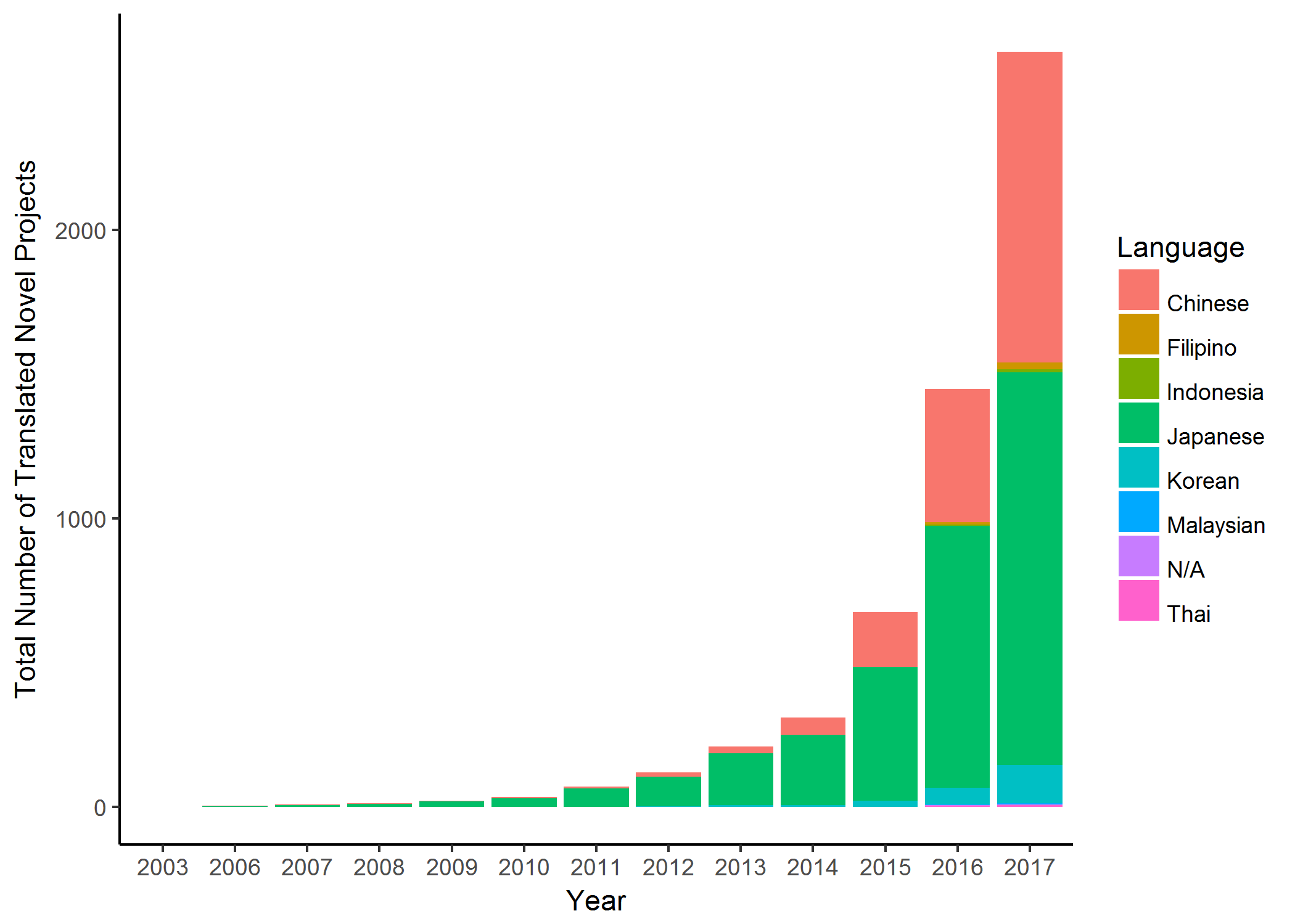
The total number of novel translations over the years
(I would really love for someone to go and put a language for the two projects that don’t have a language of origin. “Storm of Prophecy” and “Heir of Kiri”)
| 2003 | 2006 | 2007 | 2008 | 2009 | 2010 | 2011 | 2012 | 2013 | 2014 | 2015 | 2016 | 2017 | |
| Number of Novels | 1 | 3 | 4 | 5 | 9 | 13 | 35 | 50 | 90 | 100 | 366 | 774 | 1170 |
| % Growth Rate | – | – | 33 | 25 | 80 | 44 | 169 | 43 | 80 | 11 | 266 | 111 | 51 |
The figure above shows the overall increase in the number of projects, indexed on NovelUpdates, according to the year of first release. The total number of translation projects is 2888. The number of new projects started each year has increased, though particularly high growth occurred in 2011 and 2015 with a 169% and 266% increase in the number of new projects over the previous year, respectively. Growth has also been uneven, with particular lows in 2014 and 2012 relative to preceding and following years. 2017 is the year with the highest number of new translation projects started even though the year has not yet finished.
Cumulative Monthly Growth

The figure above shows the cumulative number of novels on a month to month basis. The three most translated languages are Japanese, Chinese, and Korean.
Chinese, Japanese, and Korean Monthly Growth
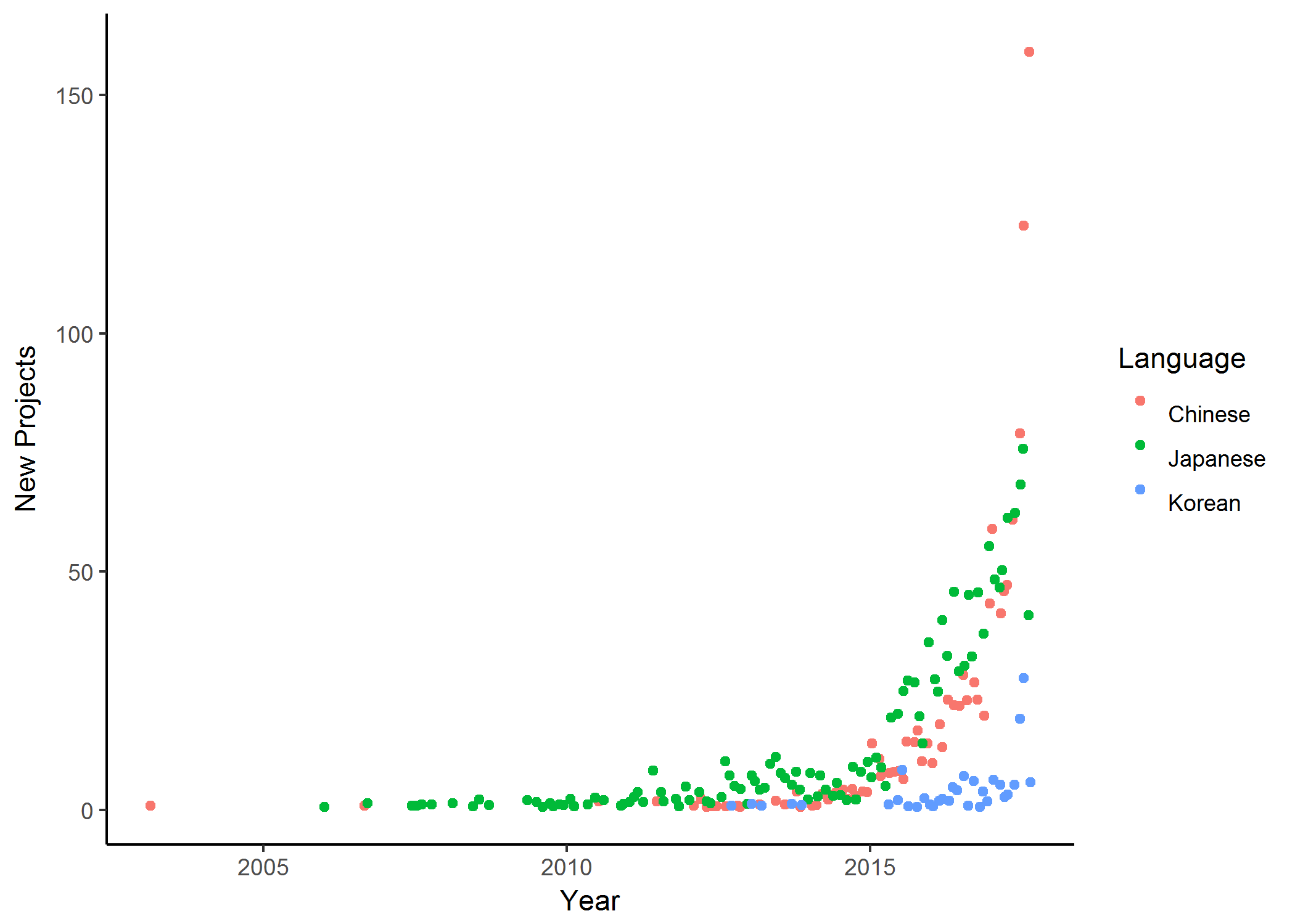
Of the three most commonly translated languages, Japanese novels are still the majority of projects translated due to a sustained growth starting in the late 2000s. Chinese novel translation projects started increasing rapidly in 2015 but has only surpassed Japanese projects in the number of new projects started each month in July 2017. Korean novels, the third largest language category, is showing increased growth in recent months but is far behind Japanese and Chinese novels.
Completed Projects
| Language | Total | Completed | Incomplete | % complete |
| Chinese | 1130 | 149 | 928 | 13 |
| Filipino | 25 | 10 | 14 | 40 |
| Indonesia | 12 | 1 | 10 | 8 |
| Japanese | 1558 | 201 | 1160 | 13 |
| Korean | 144 | 7 | 126 | 4 |
| Malaysian | 3 | 1 | 2 | 33 |
| N/A | 6 | 0 | 2 | 0 |
| Thai | 8 | 0 | 7 | 0 |
| Vietnamese | 2 | 1 | 1 | 50 |
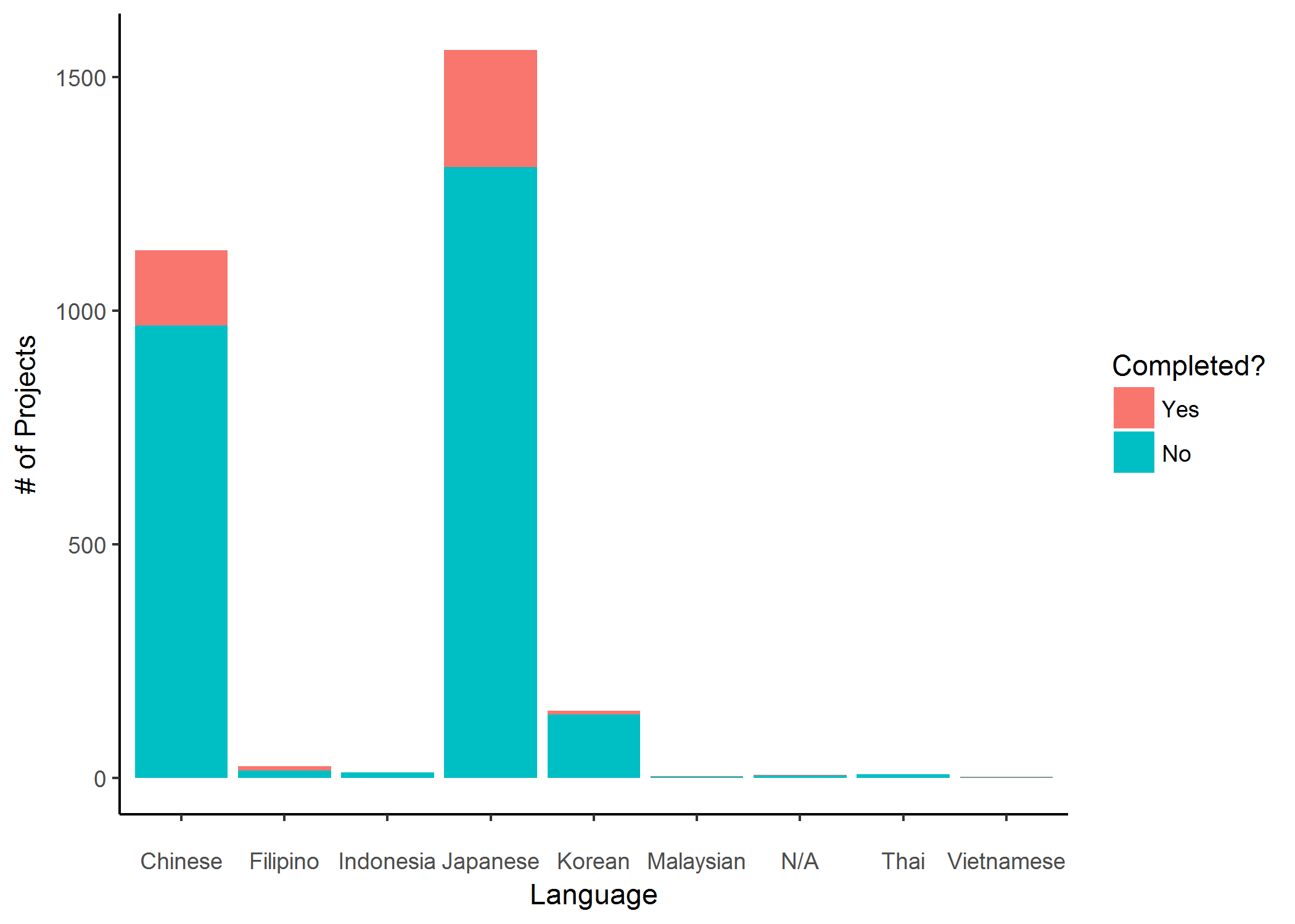
In total, there are 370 completed projects out of 2620 projects which had both a first release date, and last release date. Novels without either were excluded from the analysis. Of the three most common languages, Korean translation projects have the lowest completion rate while Chinese and Japanese projects are similar.
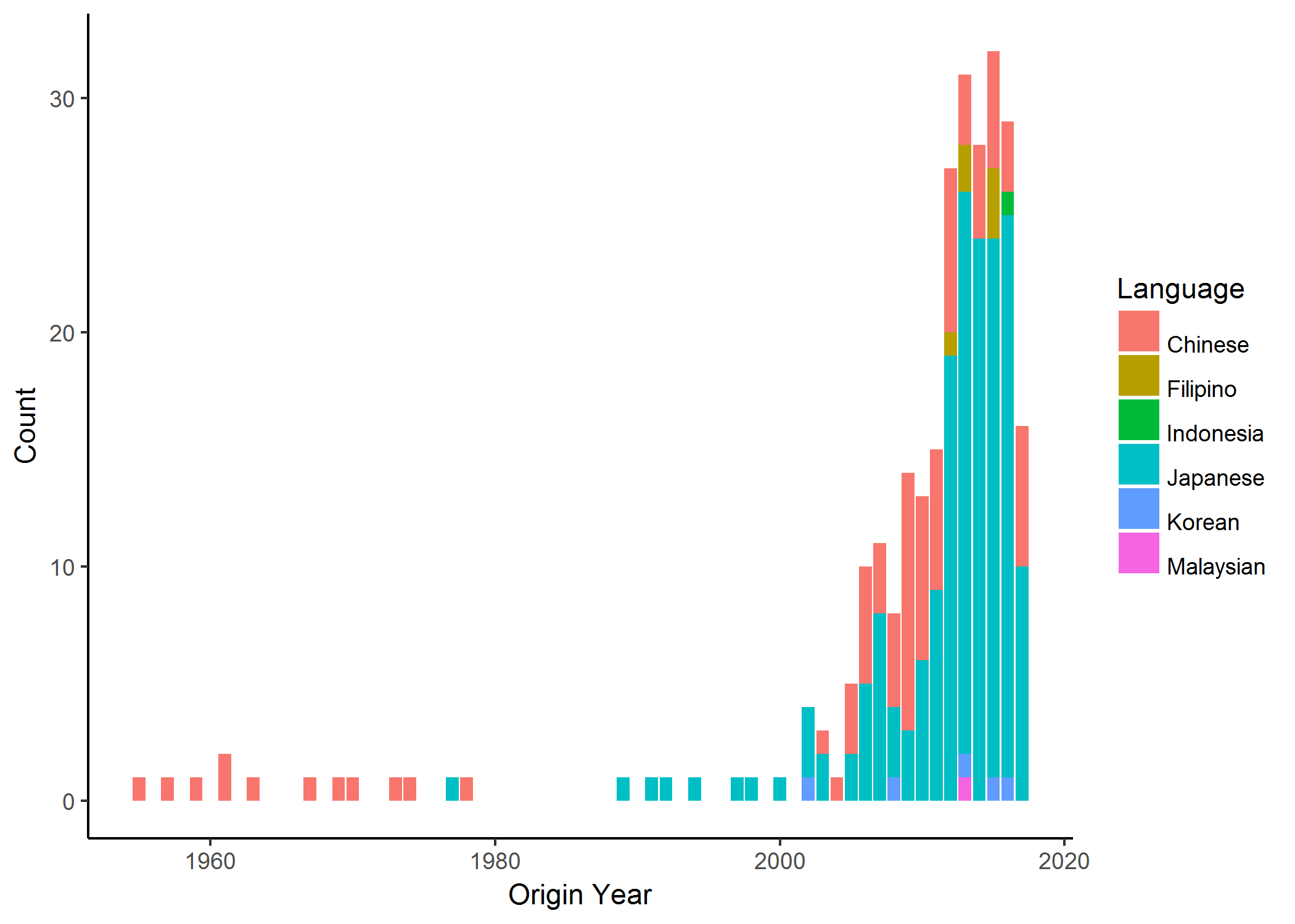
Of all 370 completed projects, only 267 had a year in country of origin. In the Novelupdates database, the oldest novel with a complete translation is “The Book and the Sword” by Jin Yong, followed by most of his other works. The oldest Japanese novel translation is “Greetings of the Universe” by Hoshi Shin’ichi. The oldest Korean novel to be translated is “Invisible Dragon” by Duchibak. In more recent times, most completed works were Japanese, and the majority of completed novels were works from the early 2010s.
How long does it take for a project to be completed?
| Language | Days |
| Chinese | 112.55705 |
| Filipino | 54.30000 |
| Indonesia | 142.00000 |
| Japanese | 137.10448 |
| Korean | 47.57143 |
| Malaysian | 9.00000 |
| Vietnamese | 0.00000 |
On average, it takes 122.5837838 days for a project to be completed. Of all languages with more than one completed project, Korean projects are the fastest to be completed with an average of 48 days, or approximately 7 weeks. Chinese, Indonesian, and Japanese projects usually take over 4 months to complete.
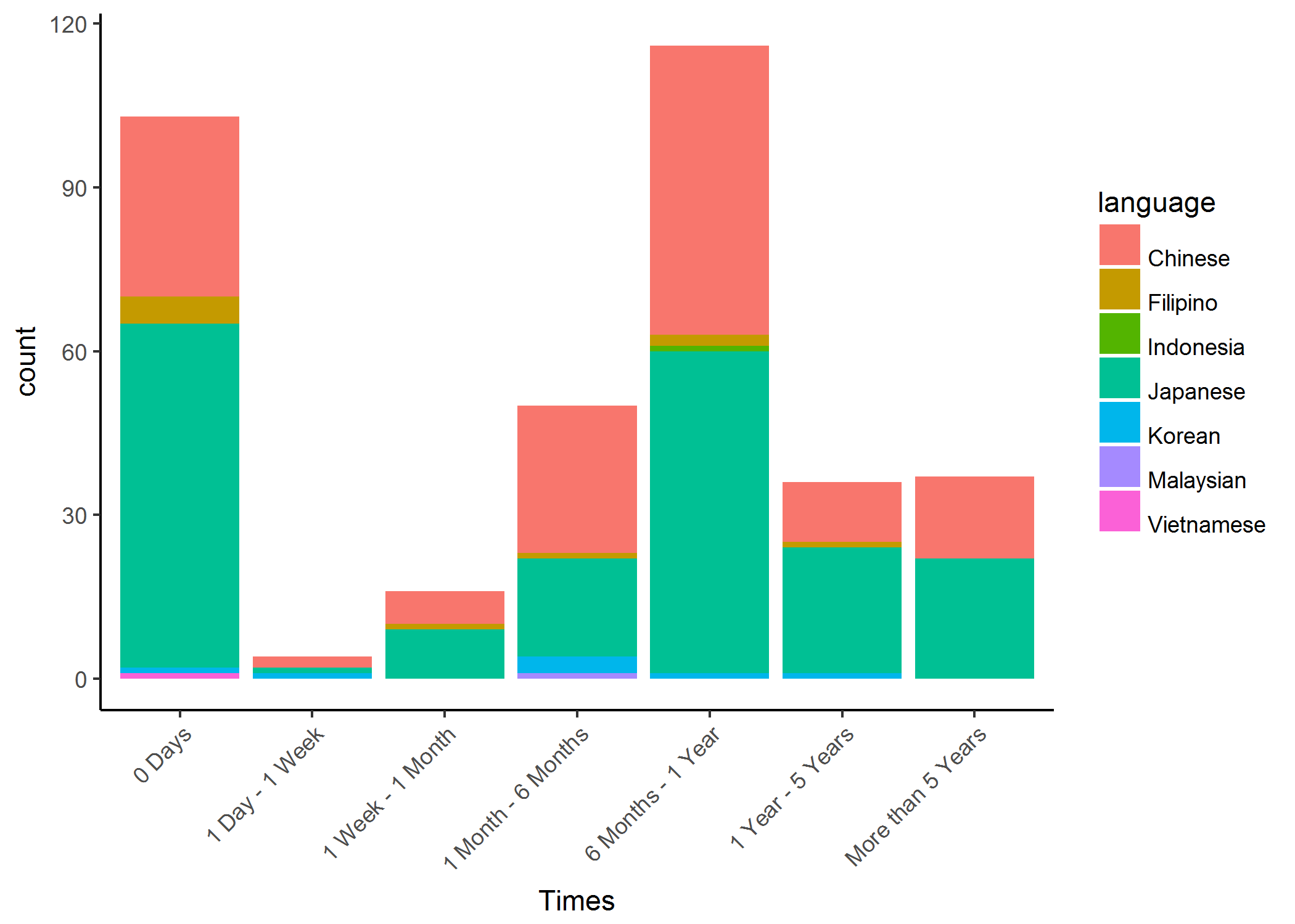
However, 103 of the 370 novel translation projects were completed in one day. This may occur for a variety of reasons such as short stories. Excluding these projects that are completed within one day, most projects take longer than a month to be completed. The novel that took the longest time to translate was “Love Times” by Konohara Narise at 1799 days or roughly 4 years and 11 months. The Chinese novel that took the longest to be completed was “Half Prince” by Yu Wo at 1710 days, or approximately 4 years and 8 months.
Top Original Publishers
461 novels did not have an original publisher filled in. Some novels had more than one publisher. Works with multiple publishers were not included as it may inflate numbers due to double-counting.
| Original Publisher | Works |
| Syosetu | 471 |
| Qidian | 368 |
| jjwxc | 133 |
| Ascii Media Works | 125 |
| 17k | 80 |
| Kadokawa Shoten | 75 |
| Fujimi Shobo | 74 |
| Munpia | 72 |
| Media Factory | 69 |
| zongheng | 60 |
Syosetu is the most popular Japanese original publisher, Qidian is the most popular Chinese original publisher, and Munpia is the most popular Korean original publisher. Additionally, Munpia is the only Korean publisher to make it onto the list of top ten.
English Licensing Status
| Language | Works Licensed | Total Number of Works | % Licensed |
| Chinese | 162 | 1130 | 14.336283 |
| Filipino | 10 | 25 | 40.000000 |
| Indonesia | 1 | 12 | 8.333333 |
| Japanese | 250 | 1558 | 16.046213 |
| Korean | 9 | 144 | 6.250000 |
| Malaysian | 1 | 3 | 33.333333 |
| N/A | 1 | 6 | 16.666667 |
| Thai | 0 | 8 | 0.000000 |
| Vietnamese | 1 | 2 | 50.000000 |
The majority of works licensed in English are Japanese works. However, Chinese, Japanese, and Korean novels have the lowest percentage rate of licensed projects to total projects.
English Licensee
| Licensing Party | Works |
| Qidian International | 72 |
| Yen Press | 45 |
| Wuxiaworld | 27 |
| June | 19 |
| Tokyopop | 19 |
| Volare Novels | 19 |
| Viz | 15 |
| Gravity Tales | 12 |
| J-Novel Club | 11 |
| Seven Seas | 9 |
There are 33 unique licensees. Of the top ten licensees with the most licenses, six (Yen Press, June, Tokopop, Viz, and J-Novel Club, Seven Seas) publish Japanese projects. Qidian International, Wuxiaworld, Volare Novels, and Gravity Tales are English publishers of Chinese projects.
Most popular month to start a project
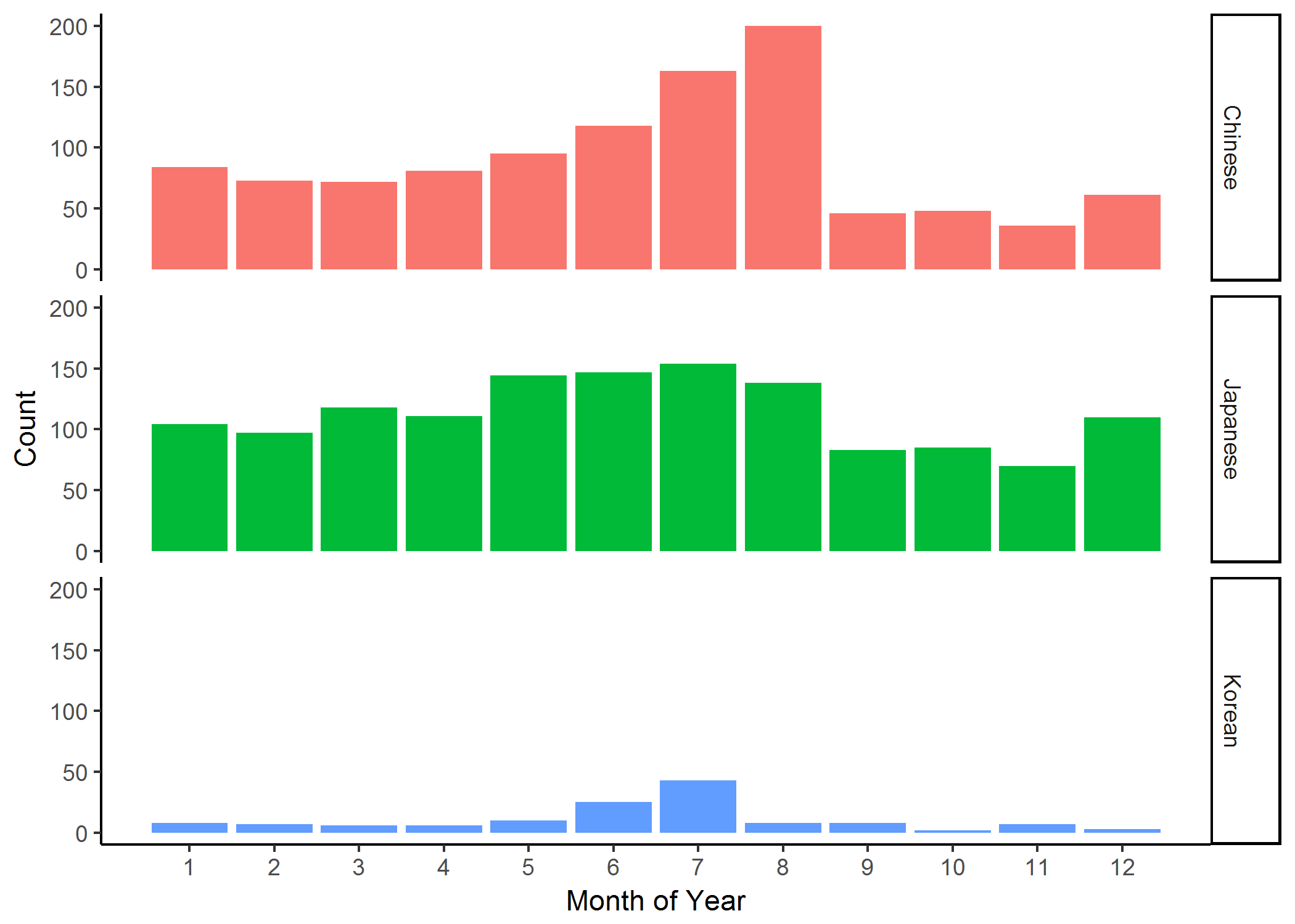
The most popular time to start a project overall is in August. The general trend for the three most common languages is higher starts during the summer months (June-August), most likely due to the end of the school year. There is a decrease in the number of projects started in September, also a possible result of the start of the school year. One factor to keep in mind is the number of new Chinese novel projects that have been started in recent months. They may be inflating the summer month values compared to later months that have not yet passed.
Tl;dr: The number of novel translations is going up, possibly doubling in number this year, the number of new Chinese translations has surpassed the number of new Japanese novel translations in July for the first time in a long time. The mean time for a translation to be finished is approximately three months. Syosetsu is the original publisher with the highest number of works translated. Qidian International holds the largest number of English licenses.
And now, translator ramblings.
Way back last August was when I decided to manually sample and see the proportion of female to male main characters. It was too time consuming and I gave up. Earlier this week, I had some free time, and tried to get data from novelupdates. The tags were too intimidating so I went for stuff that was easier. The data set is missing a lot of stuff. For example, if the links were dead and hidden, I did not get the release dates. Or if they were just in text and didn’t have a link, I didn’t get those releases either. At the end of the day, no database is going to be perfect, and I don’t have the skill to copy all of novelupdate’s data to analyze.
Some more interesting things I don’t have the time to look at: Most popular update times, the number of projects per group/individual etc etc.


Leave a Reply to AdnanaCancel reply